RESTORING THE GREAT MARSH
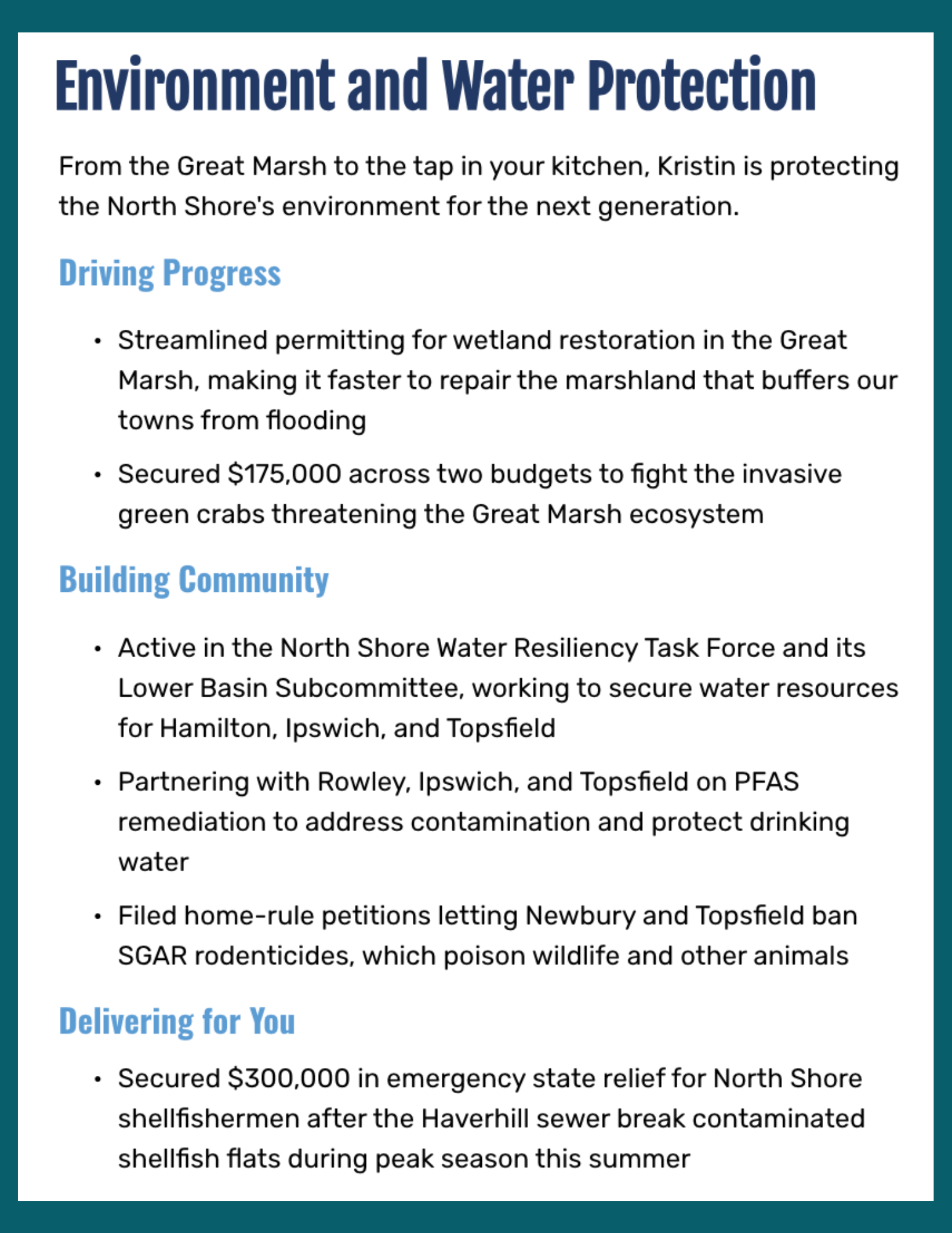
On environmental issues, Kassner’s biggest and often repeated claim is that she is the champion of wetlands restoration in the Great Marsh to ensure the longevity of this fragile ecosystem and help the towns combat the effects of climate change. Yet her principal claims in this area – streamlining permitting for conservation projects, and securing $175,000 in grants to fight invasive green crabs – represent hard work accomplished by others for which she now claims credit.
On permitting, the architects of this effort were the Massachusetts Audubon Society and the Trustees of the Reservations.
The bill, which included the permitting reforms introduced by Kassner and others in 2025, is almost an exact copy of a bill introduced in 2023 by Newburyport’s Representative and State Senator. Kassner’s role was limited to putting her name on the reconstituted bill in 2025. This bill is still stuck in a committee and has not become law. Actual successful efforts to streamline permitting have been led by MassDEP through the regulatory process rather than efforts by Kassner.
As for the $175,000 in grants to fight invasive green crabs – her claim of credit is a flat out lie. Her predecessor, Brad Hill, together with Senator Bruce Tarr, secured multiple grants adding up to $167,044 in funding. Only a fraction of that amount – $40,000 – went to towns in the 2nd Essex District. The rest went to Essex ($20,000) and Gloucester ($107,044).
RELIEF FOR THE CLAM DIGGERS
Kassner claims she “secured” $300,000 in relief for local “shellfisherman.” Again, a flat out lie. In the recent Economic Development Bill (still in committee), she asked for $600,000 in relief as a result of the Haverhill sewer break, but the bill only includes $100,000 – and, if enacted, it would be in the form of a bond – not cash – released as the Governor’s whim. What in fact happened, was the Governor, drawing from existing emergency funds, established a $300,000 relief program.
Kassner’s role was limited to thanking the Governor for her efforts. That $300,000, which is not enough, will be distributed to clam diggers from Salisbury to Rockport. Only a fraction will go to clam diggers in the district.
RESTRICTING RAT POISONS
Kassner’s rodenticide petitions were not her initiatives. These are “home rule” petitions, developed and approved at the local level – in this case by Topsfield and Newbury. Her job was limited to transporting those fully realized petitions to Beacon Hill and going through the procedural steps to turn them into law.
The petitions have not become law, as they have been folded into a broader environmental bill, which is still pending, whose primary sponsors do not include Kassner. In short, the towns did all the work, and other legislators picked up the ball to propose a broader bill supporting restrictions on rat poisons.
The same pattern runs throughout: towns, water departments, agencies, task forces, and other legislators did all the substantive work. Kassner marginally participated and now claims credit.