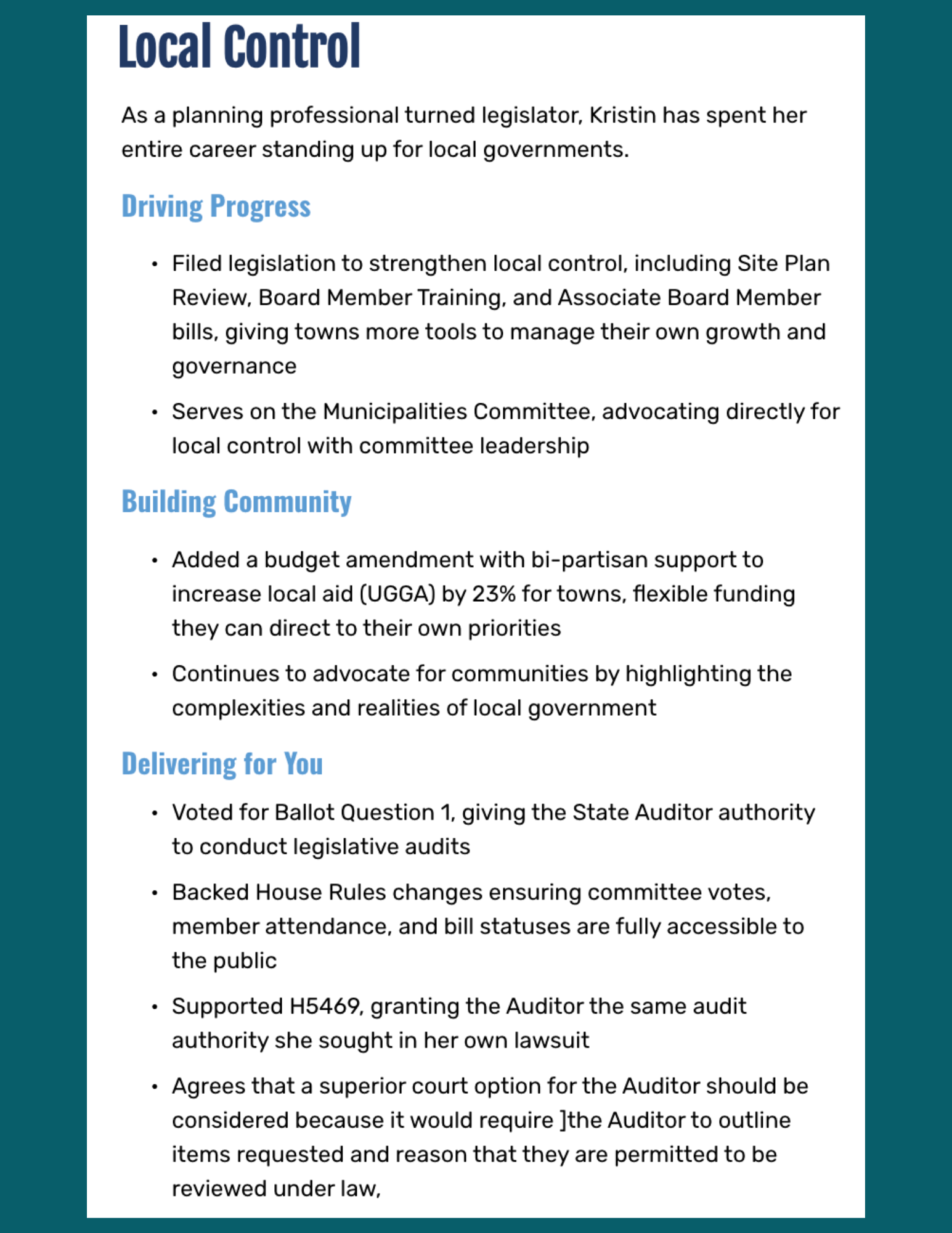
Kassner’s “Local Control” section collapses under the weight of its own contradictions.
THE AUDIT
Kassner has the audacity to claim that as a private citizen, she voted for the independent audit, while as a politician, she voted twice on measures which the Auditor herself, Diana DiZoglio, has characterized as unconstitutional attempts to kill the audit.
Kassner claims she has delivered for her constituents by supporting the most recent House bill aimed at killing the audit, H5469, and falsely claims that this bill gives the Auditor “the same audit authority she brought in her own lawsuit.” The Auditor does not agree.
SITE PLAN REVIEW
Her site plan review reform now embedded in the Economic Development Bill puts restraints on local planning boards with regard to their review of projects, creates a cookie cutter standard for review, eliminates public input, and takes away the leverage towns can use against developers to get neighborhood improvements.
Moreover, her proposed legislation imposes a 90-day shot-clock for local boards to issue a decision, creating unreasonable burdens on towns in the district who rely on part-time or volunteer planning boards to examine projects for approval.
This same bill allows multi-family housing developments, by-right, on land owned by religious institutions. This is yet another blow, in addition to 3A and 40B, to communities having control of their own destiny when it comes to local development.
UNRESTRICTED FUNDS
The towns of the Second Essex District cannot afford through property taxes alone to pay for their ever increasing operational expenses and infrastructure costs, and rely, among other things, on distribution by the state in each year’s budget of “unrestricted funds” which can be used for any purpose. With every year, that number keeps dwindling as Beacon Hill and the Governor’s office decide that our tax dollars can be better spent on their pet projects.
We are truly in Bizarro World when Kristin Kassner claims that her attempts to kill the audit, support anemic increases in unrestricted aid, and impose state-wide restrictions on town planners and planning boards further the interests of local control.