
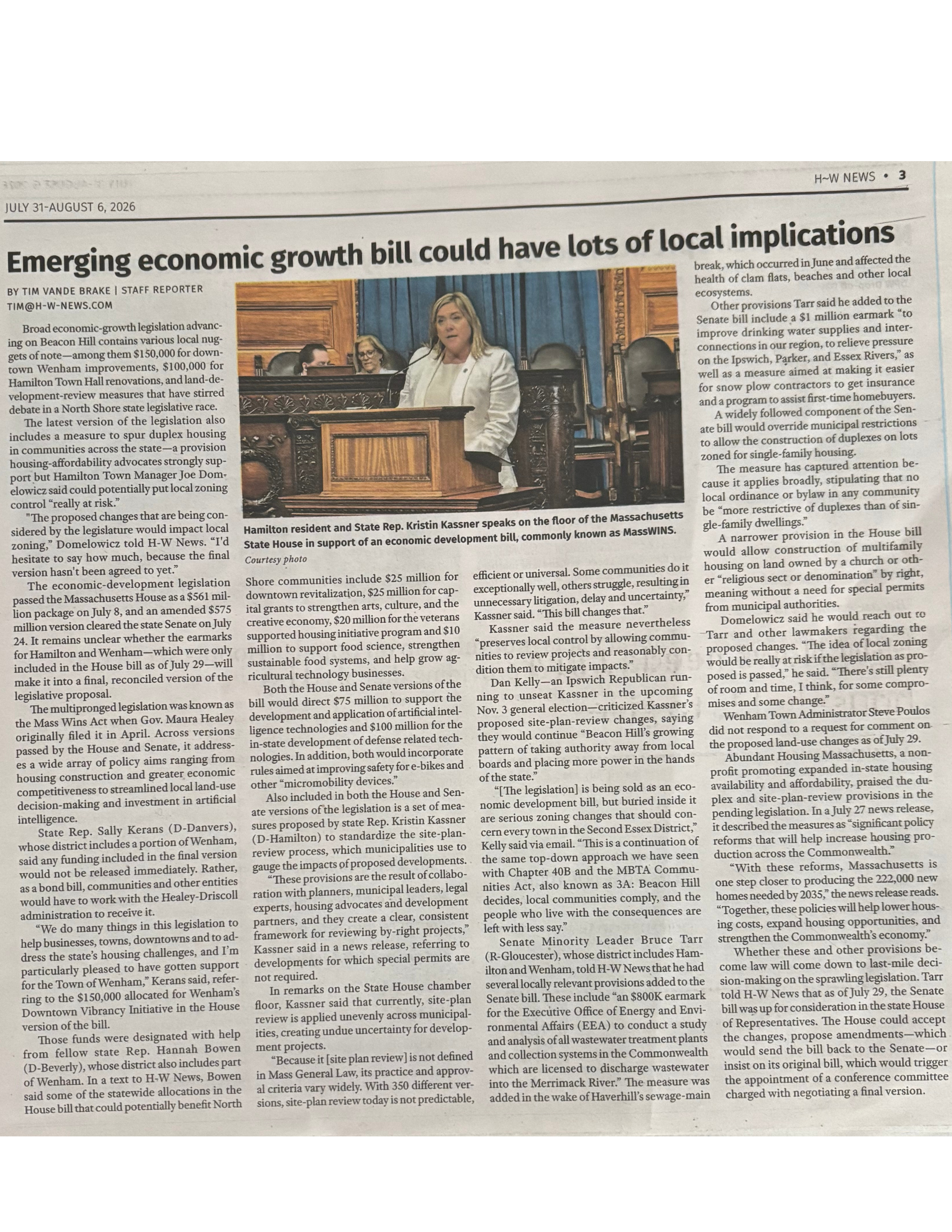
PRINT COVERAGE · H-W NEWS · JULY 31–AUGUST 6, 2026
Dan Kelly Raises Local-Control Concerns About Massachusetts Economic-Growth Bill
H-W News examines the local implications of Massachusetts’ developing economic-growth legislation, including proposed changes to site-plan review and Dan Kelly’s concerns about shifting additional zoning authority away from local communities.
Original reporting by Tim Vande Brake, H-W News
Print edition: July 31–August 6, 2026, page 3
Campaign summary prepared by The Committee to Elect Dan Kelly
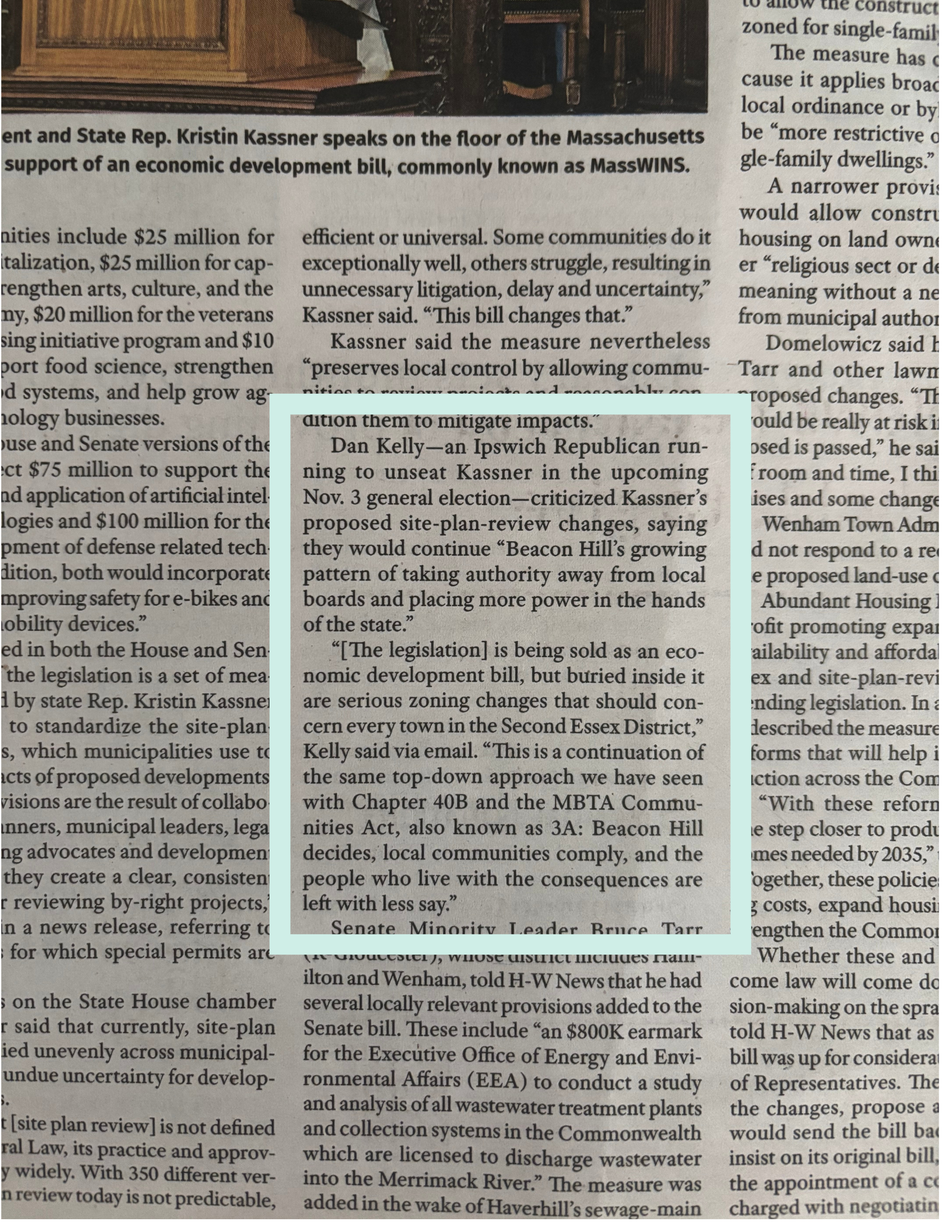
Dan Kelly, the Republican candidate for State Representative in Massachusetts’ Second Essex District, was quoted in H-W News raising concerns about zoning and site-plan-review provisions included in the state’s developing economic-growth legislation. Kelly’s concern is straightforward: significant changes to local land-use authority deserve transparent, focused public debate. They should not be overlooked because they are placed inside a much larger economic-development bill.
This H-W News article, “Emerging economic growth bill could have lots of local implications,” examines the proposed legislation from several perspectives. It includes comments from legislators, municipal officials, housing advocates, and Dan Kelly about how the different House and Senate proposals could affect communities across Massachusetts.
Coverage at a Glance
Publication: H-W News
Article: Emerging economic growth bill could have lots of local implications
Reporter: Tim Vande Brake
Issue: July 31–August 6, 2026
Page: 3
Coverage type: Print newspaper
Legislation discussed: Massachusetts economic-growth legislation, commonly referred to as MassWINS
Primary local issue: Statewide changes to site-plan review and municipal zoning authority
Dan Kelly’s role: Candidate for State Representative quoted in the article
District: Massachusetts Second Essex District
What H-W News Reported
The H-W News article examines broad economic-development legislation moving through the Massachusetts House and Senate.
At the time of publication, the two legislative branches had approved different versions of the bill. Those versions included investments in economic development, artificial intelligence, defense-related technology, food systems, downtown revitalization, water infrastructure, and other statewide and local programs.
It also identifies several land-use provisions with potentially significant local consequences.
One proposal would establish more consistent statewide standards for site-plan review. Other provisions discussed in the article concerned duplex construction, multifamily housing, and development on property owned by religious organizations. Because the House and Senate versions differed, the final language had not yet been determined when the article was published.
This page documents the coverage as it appeared in the July 31–August 6 issue.
What Is Site-Plan Review?
Site-plan review is a process municipal boards use to examine how a proposed development will function on a particular property.
Depending on local rules and the project involved, a review may consider:
Vehicle and pedestrian access
Traffic circulation
Drainage and stormwater
Lighting
Landscaping and screening
Emergency access
Parking
Utility connections
The placement of buildings and other site features
Effects on neighboring properties
Site-plan review is different from deciding whether a particular use is allowed. In many cases, the underlying project is permitted, but the municipality can review its design and establish reasonable conditions intended to address its local effects.
The debate described by H-W News concerns how much discretion local communities should retain when conducting that review and how much of the process should be standardized by state law.
Competing Positions
Representative Kristin Kassner, who sponsored the House site-plan-review proposal discussed in the article, argued that inconsistent municipal procedures create uncertainty, delay, and unnecessary litigation.
According to the article, Kassner maintained that a standardized process would create greater predictability while still allowing communities to review projects and impose reasonable conditions intended to mitigate their effects.
Dan Kelly raised a different concern.
Kelly argued that the proposal represented part of a broader pattern in which Beacon Hill establishes statewide land-use requirements while local communities are left to manage the practical consequences.
He connected the site-plan-review proposal to ongoing debates surrounding Chapter 40B and the MBTA Communities Act, commonly known as Section 3A. In each instance, Kelly believes the central question is not simply whether housing should be built. The question is who makes the decisions, how those decisions are made, and whether the people affected retain a meaningful voice.
Dan Kelly’s Position
Dan supports practical efforts to address Massachusetts’ housing and affordability challenges. He also believes that communities must retain a meaningful role in decisions that affect their roads, schools, water systems, public-safety resources, environment, historic character, and existing neighborhoods.
The Second Essex District does not consist of interchangeable communities. Georgetown, Hamilton, Ipswich, Newbury, Rowley, and Topsfield Precinct 1 each have different infrastructure, environmental conditions, housing needs, and local planning priorities.
A statewide rule may appear simple when written on Beacon Hill. Its consequences are experienced locally.
Dan believes major zoning changes should be debated openly, evaluated individually, and explained clearly to the public. Municipal officials and residents should have enough time to understand proposed language before the Legislature makes consequential changes to local authority.
Economic development and housing production are important. So are transparency, local knowledge, infrastructure capacity, and democratic participation.
Those priorities should not be treated as mutually exclusive.
Why This Matters to the Second Essex District?
Development decisions affect far more than the boundaries of an individual property.
A project may add vehicles to a local road, students to a school system, demand on public water, pressure on wastewater infrastructure, calls for police and fire services, or new stormwater and drainage concerns. These effects do not necessarily mean that a project should be rejected. They mean that the people responsible for local services must have appropriate tools to review the project and address its foreseeable effects.
Dan Kelly believes local planning boards, zoning boards, select boards, professional staff, first responders, and residents possess knowledge that cannot always be replicated through a statewide formula.
The state has an important role in addressing housing, affordability, and economic development. But state action should work with communities—not simply impose decisions upon them.
Beacon Hill or the Second Essex?
This debate reflects a larger question at the center of Dan Kelly’s campaign: Who will have the strongest voice when Beacon Hill policy affects the communities of the Second Essex District?
Dan believes the district needs a representative who will examine what is placed inside large legislative packages, explain the local consequences, and speak up when a proposal could reduce the authority of local residents and municipal officials. That does not require rejecting every state initiative. It requires evaluating each proposal on its merits and asking whether it respects the communities that must implement it.
Dan’s commitment is to place the Second Essex District first.
About the Original Coverage
This page is an original campaign summary of print reporting published by H-W News in its July 31–August 6, 2026 edition.
The original article, “Emerging economic growth bill could have lots of local implications,” was written by H-W News staff reporter Tim Vande Brake and appeared on page 3.
The Committee to Elect Dan Kelly did not write or publish the original newspaper report.
Frequently Asked Questions
Who is Dan Kelly?
Dan Kelly is an Ipswich resident, retired attorney, community volunteer, and 2026 Republican candidate for Massachusetts State Representative in the Second Essex District.
What newspaper published this coverage?
The article was published in the July 31–August 6, 2026 print edition of H-W News. It was written by staff reporter Tim Vande Brake and appeared on page 3.
What legislation was discussed?
The article examined developing Massachusetts economic-growth legislation commonly referred to as MassWINS. The House and Senate versions included economic investments, local funding, and several proposed land-use changes.
What is site-plan review?
Site-plan review is a municipal process used to examine the design and practical effects of certain proposed developments. It may address traffic, drainage, access, lighting, landscaping, parking, utilities, and other site-specific conditions.
What was Dan Kelly’s concern?
Dan was concerned that statewide site-plan-review standards could reduce municipal discretion and continue a broader movement of land-use authority away from local communities.
Does Dan Kelly oppose housing development?
Dan supports practical solutions to housing and affordability problems. His position is that housing policy should be transparent, account for local infrastructure and environmental conditions, and preserve a meaningful role for affected communities.
Which communities are in the Second Essex District?
The district consists of Georgetown, Hamilton, Ipswich, Newbury, Rowley, and Precinct 1 of Topsfield. Byfield is a village within Newbury.
Learn More
Read more about Dan Kelly’s approach to local control, housing, infrastructure, and accountable government.