
CAMPAIGN PRESS RELEASE · JULY 17, 2026
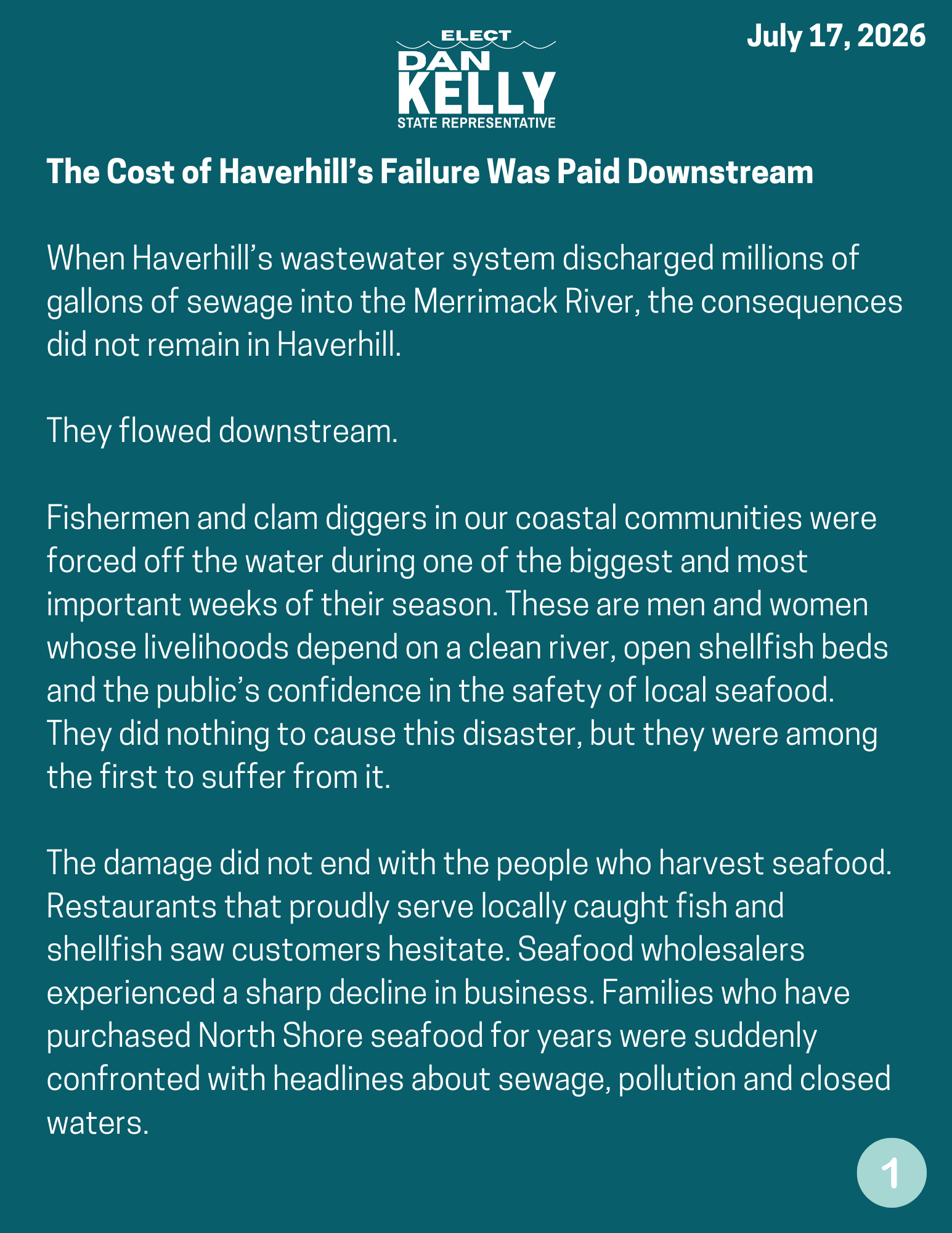
The Cost of Haverhill’s Failure Was Paid Downstream
When Haverhill’s wastewater system discharged millions of gallons of sewage into the Merrimack River, the consequences did not remain in Haverhill.
They flowed downstream.
Fishermen and clam diggers in our coastal communities were forced off the water during one of the biggest and most important weeks of their season. These are men and women whose livelihoods depend on a clean river, open shellfish beds and the public’s confidence in the safety of local seafood. They did nothing to cause this disaster, but they were among the first to suffer from it.
The damage did not end with the people who harvest seafood. Restaurants that proudly serve locally caught fish and shellfish saw customers hesitate. Seafood wholesalers experienced a sharp decline in business. Families who have purchased North Shore seafood for years were suddenly confronted with headlines about sewage, pollution and closed waters.
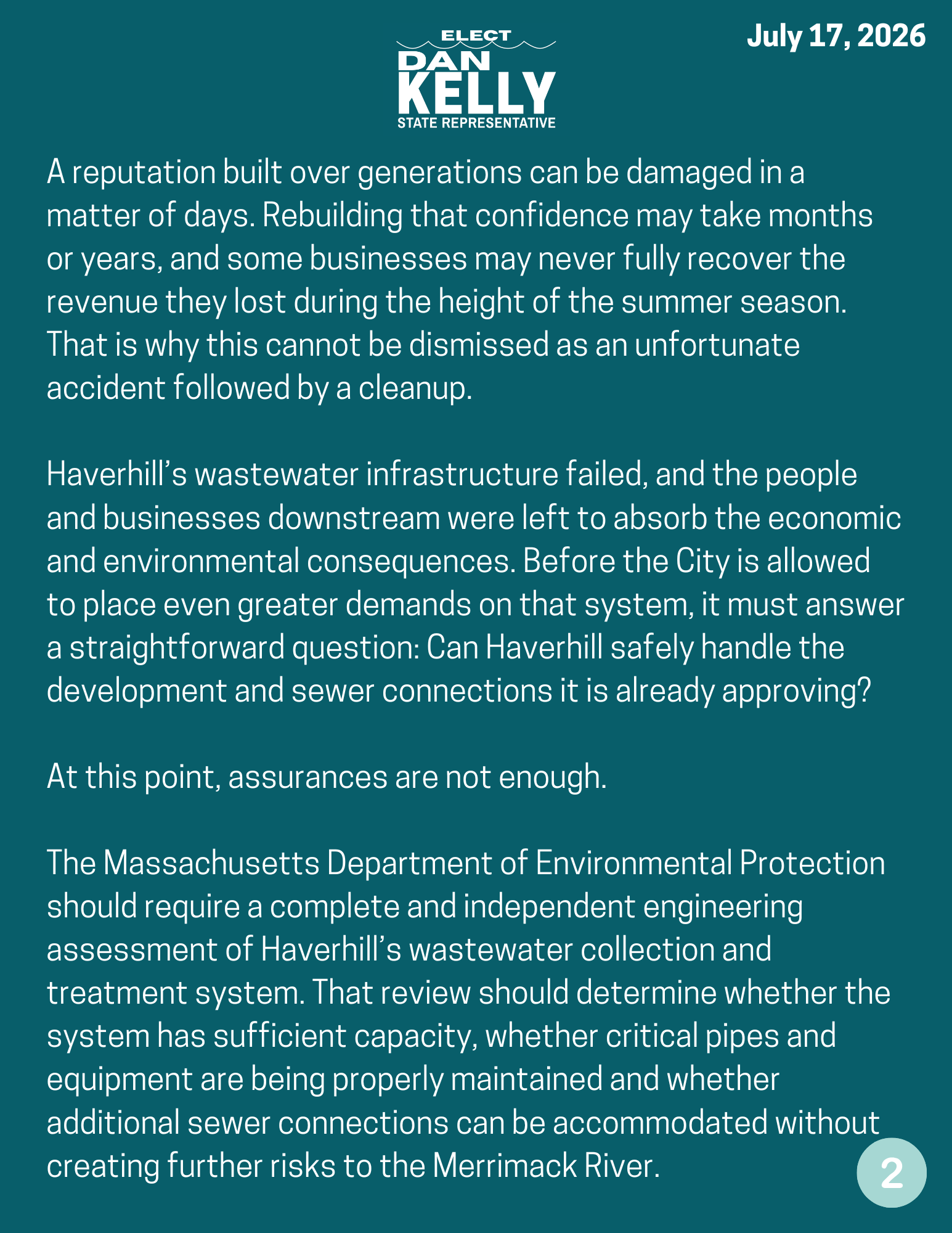
A reputation built over generations can be damaged in a matter of days. Rebuilding that confidence may take months or years, and some businesses may never fully recover the revenue they lost during the height of the summer season. That is why this cannot be dismissed as an unfortunate accident followed by a cleanup.
Haverhill’s wastewater infrastructure failed, and the people and businesses downstream were left to absorb the economic and environmental consequences. Before the City is allowed to place even greater demands on that system, it must answer a straightforward question: Can Haverhill safely handle the development and sewer connections it is already approving?
At this point, assurances are not enough.
The Massachusetts Department of Environmental Protection should require a complete and independent engineering assessment of Haverhill’s wastewater collection and treatment system. That review should determine whether the system has sufficient capacity, whether critical pipes and equipment are being properly maintained and whether additional sewer connections can be accommodated without creating further risks to the Merrimack River.
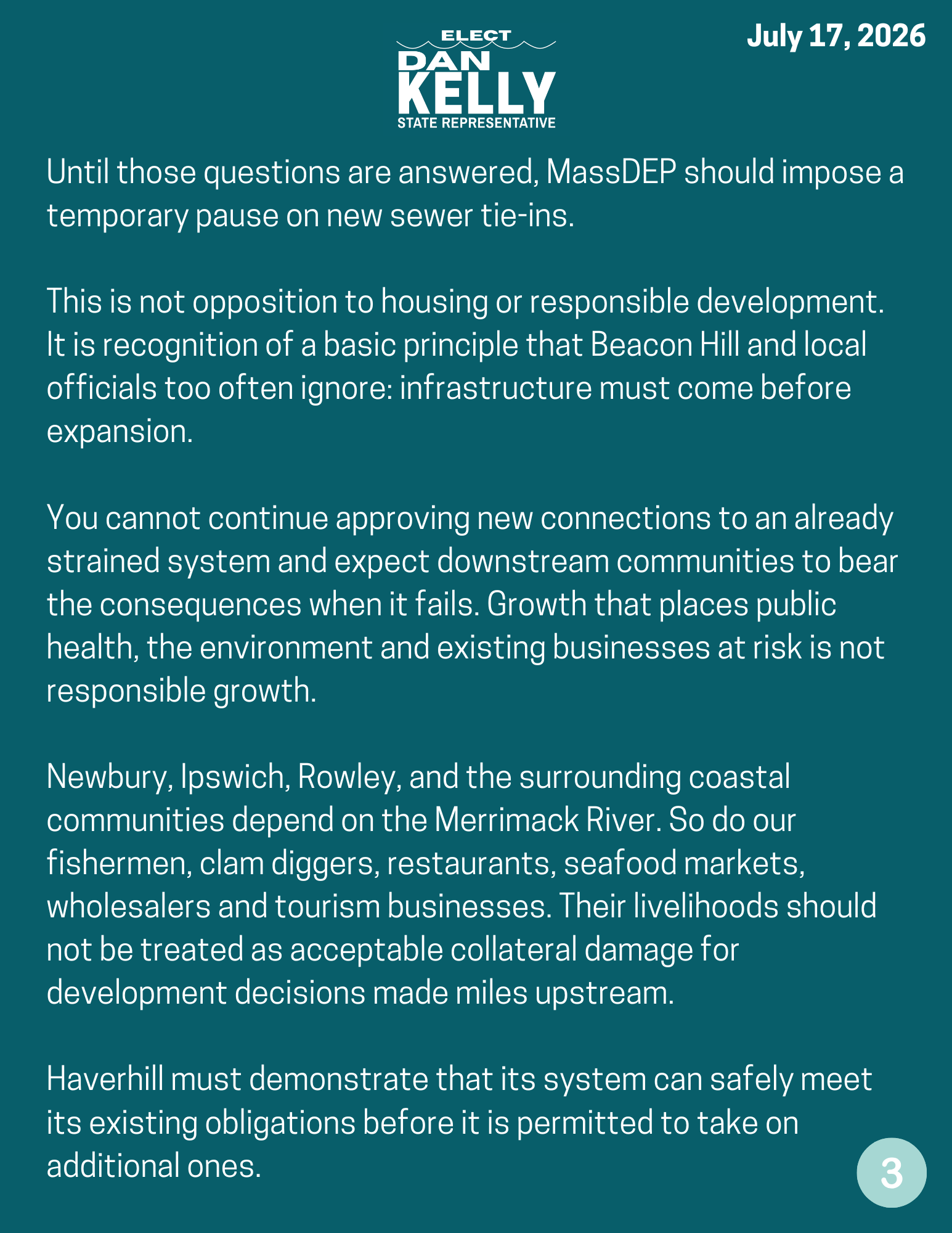
Until those questions are answered, MassDEP should impose a temporary pause on new sewer tie-ins.
This is not opposition to housing or responsible development. It is recognition of a basic principle that Beacon Hill and local officials too often ignore: infrastructure must come before expansion.
You cannot continue approving new connections to an already strained system and expect downstream communities to bear the consequences when it fails. Growth that places public health, the environment and existing businesses at risk is not responsible growth.
Newbury, Ipswich, Rowley, and the surrounding coastal communities depend on the Merrimack River. So do our fishermen, clam diggers, restaurants, seafood markets, wholesalers and tourism businesses. Their livelihoods should not be treated as acceptable collateral damage for development decisions made miles upstream.
Haverhill must demonstrate that its system can safely meet its existing obligations before it is permitted to take on additional ones.
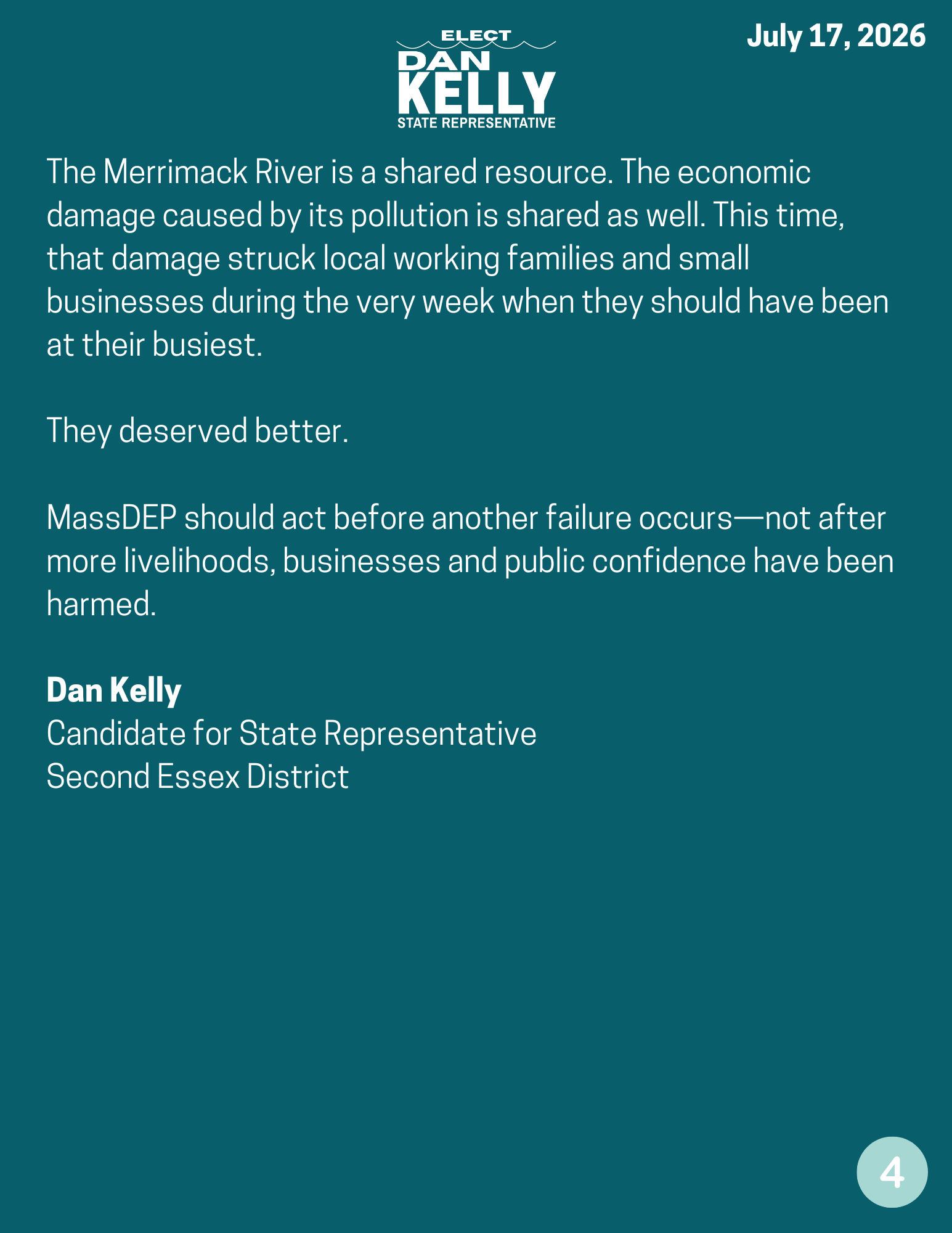
The Merrimack River is a shared resource. The economic damage caused by its pollution is shared as well. This time, that damage struck local working families and small businesses during the very week when they should have been at their busiest.
They deserved better.
MassDEP should act before another failure occurs—not after more livelihoods, businesses and public confidence have been harmed.
Dan Kelly
Candidate for State Representative
Second Essex District
What Happened in Haverhill?
At approximately 9 p.m. on June 26, 2026, Haverhill experienced two failures in the 42-inch sewer force main that carries most of the city’s wastewater from the South Mill Street Pumping Station to its wastewater treatment plant. Haverhill estimated that approximately eight million gallons of untreated wastewater per day were entering the Merrimack River while emergency work was underway.
The city stopped the discharge on July 1 by placing a temporary bypass system into operation. Haverhill subsequently reported that the bypass system included five pumps and two 24-inch pipelines capable of conveying up to 30 million gallons per day. The city also announced plans to inspect the remaining force main using closed-circuit television and evaluate additional methods of identifying defects or deterioration.
READ HAVERHILL’S OFFICIAL RESPONSE UPDATES
Downstream Closures and Economic Effects
The wastewater discharge prompted public-health advisories and temporary closures of beaches and shellfish-growing areas in downstream communities. The Massachusetts government reported that the incident affected shellfish areas and beaches throughout the North Shore. Emergency shellfish closures included areas in Ipswich, Newbury, Rowley, and other coastal communities.
The state subsequently announced $300,000 in financial relief for shellfish harvesters and oyster growers affected by a 12-day emergency closure.
These closures help explain why a failure outside the Second Essex District became an issue for its residents. The river, coastal waters, seafood economy, and public confidence do not stop at municipal boundaries.
READ THE STATE’S MERRIMACK OVERFLOW RESPONSE
READ THE STATE’S SHELLFISH-CLOSURE INFORMATION
READ THE SHELLFISH-HARVESTER RELIEF ANNOUNCEMENT
What Dan Kelly Requested
In his July 17 statement, Dan Kelly called for two specific actions.
1. A Complete and Independent Engineering Assessment
Dan called on MassDEP to require a review of:
The condition of Haverhill’s wastewater collection and treatment system
The system’s present capacity
The maintenance of critical pipes and equipment
The ability of the system to accommodate additional sewer connections
The potential risks that additional demand could create for the Merrimack River and downstream communities
Haverhill had already announced pipeline inspections and an engineering evaluation as part of its emergency response. Dan’s proposal called for a broader, independent assessment under MassDEP oversight before additional demands were placed on the system.
2. A Temporary Pause on New Sewer Tie-Ins
Dan called for a temporary pause—not a permanent prohibition—until the relevant capacity, maintenance, and safety questions could be answered.
His position was not that housing and development should stop. His position was that public infrastructure must be capable of safely supporting development before additional connections are approved.
Why This Matters to the Second Essex District
Haverhill is not part of the Second Essex District, but the consequences of the wastewater failure did not remain within Haverhill. Newbury, Ipswich, and Rowley are downstream communities within the Second Essex District. Their residents, shellfish harvesters, fishermen, restaurants, seafood businesses, tourism economy, and natural resources can be affected by decisions and infrastructure failures elsewhere in the Merrimack River watershed.
The incident illustrates a broader principle: when one community’s infrastructure affects a shared natural resource, other communities deserve a voice in how the risks are evaluated and addressed. Dan believes development decisions must account for the infrastructure needed to support them and the people who may bear the consequences when that infrastructure fails.
Infrastructure Before Expansion
Dan Kelly supports responsible housing and economic development. He also believes that development must be supported by adequate wastewater, water, transportation, public-safety, and school infrastructure.
Calling for infrastructure to come before expansion means asking whether a proposed increase in demand can be safely accommodated and who will bear the cost if it cannot.
Frequently Asked Questions
What caused the 2026 Haverhill wastewater discharge?
Haverhill reported that torrential rainfall on June 26 placed increased demand on a 42-inch sewer force main. Two failures were discovered in the pipeline, resulting in untreated wastewater entering the Merrimack River.
How much wastewater entered the Merrimack River?
During the emergency, Haverhill estimated that approximately eight million gallons per day were entering the river. The estimate was based on average flow through the South Mill Street Pumping Station.
When did the discharge stop?
Haverhill reported that the untreated wastewater discharge stopped on July 1, 2026, after a temporary bypass system was placed into operation.
Which Second Essex communities were affected?
Emergency shellfish closures included areas in Ipswich, Newbury, and Rowley, all of which are within the Second Essex District.
Why did Dan Kelly comment on an incident in Haverhill?
Although Haverhill is outside the Second Essex District, wastewater entering the Merrimack River moved downstream toward communities that Dan is running to represent. The closures affected local natural resources, shellfish harvesters, businesses, residents, and public confidence in North Shore seafood.
What did Dan Kelly ask MassDEP to do?
Dan asked MassDEP to require a complete and independent engineering assessment of Haverhill’s wastewater collection and treatment system. He also called for a temporary pause on new sewer tie-ins until questions concerning capacity, maintenance, and safety were answered.
Did Dan Kelly call for a permanent sewer moratorium?
No. The statement called for a temporary pause until the requested assessment could determine whether the system could safely meet its existing obligations and accommodate additional connections.
Does Dan Kelly oppose housing or development?
No. The original statement expressly says that the proposal is not opposition to housing or responsible development. Dan’s position is that infrastructure must be able to support expansion safely.
What did Haverhill do after the failure?
Haverhill installed a temporary bypass system, stopped the discharge, began excavating the damaged sections, and announced inspections and engineering evaluations of the force main while permanent repairs were being developed.
Learn More
Read more about Dan Kelly’s positions on infrastructure, local businesses, coastal communities, environmental protection, and responsible development.